How to Build Muscle After 40 Without Lifting Heavy: A Strength Coach's Method for Midlife Women
Raise your hand if you've been told you need to lift heavy weights to maintain muscle after 40. Now raise your hand if you've tried it and your body said absolutely not. Joints, fatigue, feeling wrecked for two days after. Or you don’t even want to try because it sounds so miserable. Yeah. That's a lot of us.
Here's the thing: the advice isn't wrong. It's just that nobody has given us a better option. Until now.
This conversation, with strength coach Ashley Selman, is about a method called blood flow restriction training. She has 30 years of experience, has trained Olympic athletes, and now works with midlife women who want to build muscle without destroying themselves in the process. The short version: 5-pound weights, 20-minute workouts at home, and the same muscle-building hormonal response as heavy lifting. The science is real, and once she explains how it works, it makes complete sense.
This is for you if you've been thinking:
"I keep hearing I need to lift heavy, but every time I do, something hurts."
"I'm too tired to do intense workouts. I can barely sleep as it is."
"I've been working out consistently and I'm still gaining weight. What is happening?"
"I want to build muscle but I don't want to go to a gym and I don't want to hurt myself."
"Is there a way to stay fit in my 40s and 50s that actually fits my life?"
Prefer to listen? Press play below:
Or listen on:
Apple Podcasts | Spotify | YouTube
What Is Blood Flow Restriction Training?
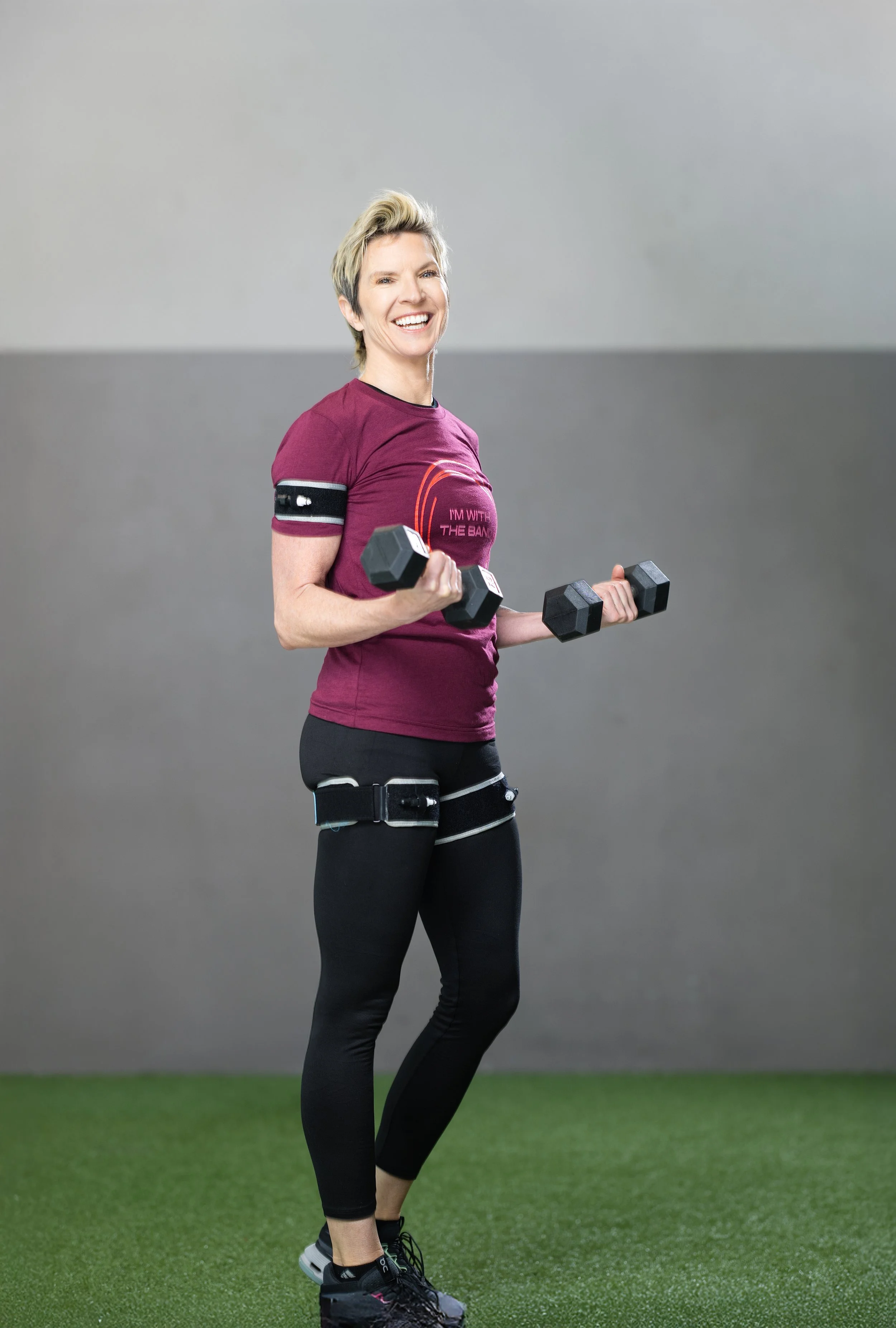
BFR training uses specialized cuffs worn on your arms or legs to partially slow venous blood flow during exercise. Venous blood flow is the blood traveling out of your muscles back to your heart. By slowing it down, the muscle holds more blood, fatigue accumulates faster, and your body responds as if it's working much harder than it actually is.
The technique was developed in Japan in the 1960s and has been refined over the past 20 to 30 years. Today's bands are designed so that they can't cut off arterial blood flow (blood going to the muscles), which is what makes the method safe. Physical therapists have used it for post-surgical rehab for years. Now it's available for home use.
Why It Works: The Science in Plain Language
Here's what happens physiologically during a BFR workout, per Ashley:
The reduced oxygen in the muscle causes fast fatigue, faster than it would with regular weights.
That fatigue recruits your Type 2 muscle fibers, the powerful fibers you normally can only activate by lifting very heavy.
Lactic acid accumulates. Your brain interprets this as major exertion.
Human growth hormone (HGH) is released. This is the same hormonal response you'd get from a heavy lifting session.
The result: you're triggering the same muscle-building and fat-burning pathways as heavy lifting, using weights that are 50% lighter, in a 20-minute session.
Why BFR Is Especially Effective for Midlife Women
Experts often tell women in perimenopause and menopause to lift heavy because changing hormones make it harder for the body to respond to normal exercise stimulus. You need more signal to get the same result. The advice is correct, but the execution is the problem.
As Ashley puts it: "We're also the most fragile we've ever been. Our tendons and muscles aren't recovering as fast. We're lacking sleep and energy. So telling someone to go lift as hard as they can is not the right recipe."
BFR creates that stronger signal without the heavy load. It's the same physiological argument for lifting heavy, achieved in a way your body can actually handle right now.
BFR and Weight Loss: What the Research Shows
One of the hormones most responsible for body fat regulation is human growth hormone. HGH breaks down body fat into fatty acid so the body can use it as fuel. It drops in midlife right alongside estrogen and progesterone. That's a big part of why the old calorie math stops working.
BFR has been shown to significantly increase HGH naturally. Ashley shared a case study: a woman on a GLP-1 medication who had lost 60 pounds, but 50% of that loss was muscle. After one month of BFR, she gained 6 pounds of muscle, lost 6 pounds of fat, and reduced her body fat percentage by 3%. For the first time in her weight loss journey, her fat actually went down because her muscle was going up.
The Cardio Benefit Nobody Expects
BFR training isn't just a strength method. When the bands restrict blood flow, your heart has to work harder to pump oxygen to the muscles. The effect is similar to training at altitude: more cardiovascular demand from the same movement. Clients report that hills they used to struggle with on bikes or runs suddenly feel easy. Heart rate during a BFR session can hit the same zone as a traditional cardio workout, through squats and rows.
How to Get Started
Ashley's Seli Strength program offers live Zoom classes and on-demand recordings, three sessions per week (full body, upper, lower). The equipment list: specialized BFR cuffs, light dumbbells (10 pounds or less), and resistance tubing. That's it.
She recommends 2 to 5 pound weights for beginners, 5 to 8 pounds for intermediate, with workouts capped at 20 minutes. The program is fully virtual.
FAQs
Is blood flow restriction training safe?
Yes. BFR only restricts venous blood flow (blood leaving the muscle), not arterial flow (blood entering the muscle). The bands used in consumer programs are designed to make arterial restriction impossible. The method has been studied for decades and is used routinely in physical therapy and post-surgical recovery.
Can I build muscle without lifting heavy weights after 40?
Yes. BFR creates the same muscle-building hormonal response as heavy lifting by triggering fast fatigue and HGH release through light-weight training. Research shows similar muscle-growth outcomes at 20 to 30% of a one-rep max.
How long does a BFR workout take?
About 20 minutes. The fatigue mechanism is fast, so sessions are shorter than traditional strength training.
Can BFR help with menopause weight gain?
Yes. It increases HGH, which plays a key role in breaking down body fat, especially around the midsection. It also builds muscle, which supports long-term metabolic health.
Do I need special equipment?
Yes, specialized BFR cuffs are required. These are different from regular exercise bands and are designed with a specific bladder structure that makes arterial occlusion impossible. Light dumbbells and resistance tubing complete the setup.
Meet Ashley Selman:
Ashley has been a strength coach for over 30 years, working with everyone from elite athletes like Jackie Joyner-Kersee and Brandi Chastain, to collegiate programs at Stanford University and the University of Oregon, to people in midlife who simply want to feel strong, steady, and confident again.
She’s the owner and founder of Evolution Trainers in Mountain View, California—voted the number one health club in Silicon Valley—and was recognized as one of the Top 100 Trainers in the U.S. by Men’s Health.
She is now the founder of Seli Strength, a virtual strength training platform built around one simple idea: Train smarter. Not harder.
She’s obsessed with the science of strength and longevity, but she’s even more committed to helping real people get real results—without wrecking their joints or their schedules.
Connect with Ashley Selman:
-
Jessica Long (00:00)
How many times have you heard that you have to lift heavy weights, otherwise you're going to lose all your muscle. And maybe you've tried, but you're tired from not sleeping. Your body hurts in ways it never has before, or you don't want to injure yourself, much less spend your precious time in a bro gym. Well, if that's you, then this episode is your dream come true because today you're going to learn how you can build muscle, improve your metabolism and sleep better by working out 20 minutes a day, three times a week, lifting five to 10 pound weights.
Today's guest, Ashley Selman, is a strength coach with over 30 years of experience working with elite athletes, top university programs, and now midlife women who want to feel strong and confident again. She's the founder of Sully Strength, a virtual training platform built on one simple idea, train smarter, not harder. And today she's breaking down a method that might completely change how you think about strength training after 40. You're definitely going to want to hear this one.
Jessica Long (00:56)
Hello, my friend. You are in the right place. This is where smart and sassy women over 40 come to figure out all things midlife. We talk hormones, careers, relationships, and everything in between. I'm Jessica Long, health coach and fellow midlife woman on this wild ride with you. Stick around for honest conversations with experts, rebels, and wise women rewriting midlife on their own terms. Let's dive in.
Jessica Long (01:20)
Hallelujah, there is an alternative to lifting heavy weights for midlife women. And Ashley Selvin is here to tell us all about it. Ashley, thank you so much for coming on the show.
Ashley (01:25)
Yay!
Thanks for having me here. Love that intro. ⁓
Jessica Long (01:33)
can't
tell you how many people are going to be so happy to hear that there's an alternative. So let's start at the beginning. This alternative is called blood flow restrictive training or restriction training. I actually don't know which one is it restriction. Okay. What is that?
Ashley (01:44)
Restriction.
Yeah, I know. Well, first of all, it's a horrible name, right? So when people first hear it, they're like, that sounds like a bad idea. But it's not what you need to understand if someone's hearing about it for first time. You're not fully restricting your blood flow. So it's partially restricting your venous blood flow. It is super safe. It was developed in Japan in the 1960s. It's been perfected in the last 20, 30 years in terms of having the proper bands that are completely safe.
So that's usually the first barrier is people like that doesn't sound safe, but it is. And there's been, a growing number of studies, being done in this area because there's so much potential. But what it is, is you wear these specialized cuffs. If you're watching on video, I can just show you real quick, but they just, they're just a little rubber and Velcro cuff. They're not overly intimidating. You just wrap it on your arm and then you use a pump.
and you pump them up to the pressure that is recommended on the band to start with. And what that does is it creates enough pressure on your arm to slow down venous blood flow. And the reason that's good, especially in the context of not having to lift heavy, is that the reduction in oxygen causes a super fast fatigue. Like your fatigue happens much faster in the muscle and your slow twitch muscle fibers, your type one start to
get really fatigued without oxygen and your type two muscles, which are our stronger, more powerful muscles that we lose as we age and typically can only be recruited under heavy lifting. With this method, we can recruit them with light lifting because of the lack of oxygen. So they jump in, you also increase lactic acid. A lot of people have heard of that and sometimes you think of that as a negative thing, like it's a negative byproduct, but it's actually.
a great source of fuel for our body and our brain interprets it as if there's massive fatigue happening. so human growth hormone and other amazing hormones that build muscle are released. Again, this happens when you work out really hard or with really heavy weights, but we're able to get those same results with very light weights because of using these cuffs that lightly restrict venous blood flow.
Jessica Long (04:07)
my gosh, there's already a lot out here. First of all, what is Venus blood flow?
Ashley (04:09)
Hahaha!
Great question. So we have in our vascular system, we have arteries, is blood coming from the heart into our muscles. And we have veins that take blood out of the muscle and back to the heart. So we're not slowing down the blood that's going into our muscles, but we're slowing how quickly the blood can leave the muscles, which means fatigue accumulates and the blood lactate accumulates in the blood because it's not leaving the muscle as quickly. And
Overall, it's gonna slow down your blood flow a little bit in a way that just increases fatigue But I say Venus because if you fully occluded your artery like if you were wearing a tourniquet and you fully stopped your arterial flow that can be dangerous. And that's why people think who blood flow restriction that doesn't sound good Yeah, that's a good instinct because we do not want to cut off our blood flow for a long period of time now when someone gets their blood pressure taken
they're stopping your blood flow for a very short period of time. But this method does not do that. It does not stop arterial flow. So that's an important distinction when you're talking about the safety element of this. this is in fact a very safe, it's been studied hundreds, thousands of studies now, and it's shown to be very safe.
Jessica Long (05:26)
think it's a hugely important distinction because even I've known about this for a month, but I didn't know that distinction. I mean, it makes sense now that I'm thinking about my experience with it and how my arms start to feel full after I've been wearing them for a while. But I think the common person when they hear blood flow restriction, they're thinking you're restricting the blood that's flowing to the muscle, not the blood that's flowing out of the muscle. So since you're restricting the blood that's flowing out of the muscle,
Ashley (05:38)
Thanks, Mia.
Correct. Yep.
Jessica Long (05:54)
this must mean that you can't wear these bands that long. Like I said, I've been using them now for five, six months and I noticed my arms start to feel kind of full and my veins start popping. and you said, you feel that burn faster. So for those reasons, does that mean that we're not wearing them that long?
Ashley (06:10)
Great question. So two things, we're slowing down venous blood flow, but we're not fully stopping venous blood flow. So yes, your veins, you'll start to see your veins a little more because they're holding more blood in them. But every time you exercise, venous blood flow does still push past the van, but it's just slowing down. So if it was fully stopping it, then that would be even a short amount of time. That said, we don't need to wear the bands for very long. About 20 minutes is about the most you need to wear them.
The good news about that is the workouts don't need to be longer than 20 minutes. And that's because, and even less when someone's first starting, honestly, but that's because the fatigue happens so fast and the hormonal and metabolic response from your body comes from the fatigue, not how long you've worked out. So you're getting results in 15, 20 minutes that you might need 45 minutes to an hour with regular training to get the same results. So.
The huge benefits of these bands are you can use light loads and short workouts and get legitimately scientifically studied, proven same results as heavy lifting with longer workouts. So it's a game changer.
Jessica Long (07:17)
OK, a lot of people
are thinking, my god, this is what I've been wanting to hear. Finally, some good news for midlife women. Hallelujah. OK, tell us about the lightweights. Why are we not lifting heavy when we're wearing the bands? And why do we get the same benefit from the lightweights? And when we say light, what are we talking, like two pounds, three pounds, five pounds?
Ashley (07:21)
Hahaha!
Yeah, so.
Yeah, it depends on the person. If they're new to strength training, I would say two to three pounds. If they're intermediate, I would say five pounds. If someone's more advanced, maybe eight to 10 pounds. It also depends on which exercise you're doing. Obviously the more isolated exercise with a smaller muscle group, you're going to go a little lighter. And then if you're doing a big, full body squat maybe you're going a little heavy, but it's always going to be at least 50 % lighter than what you would regularly lift.
for that exercise. technically in the science, they say it's 20 % to 30 % of your one rep max, but most people don't really know what their one rep max is. So I like saying 50 % of kind of what you would normally pick up if you were going to do that exercise. So considerably lighter, lighter enough that for most people that struggle with joint issues or maybe they have an injury that heavier lifting might bother, you can go light enough with blood flow restriction.
not exacerbate that injury or that joint issue so you can get stronger without exacerbating your injury or causing more inflammation. So many people have done this program, if they have pain in their body somewhere, their pain significantly improves. And that's because they're able to get stronger without stressing the body part that tends to bother them.
Jessica Long (08:55)
What makes this so intriguing for a lot of midlife women who are dealing with joint pain, arthritis, and also just overall fatigue? Like it's actually unsafe to go and try to lift super heavy weights when you can't get a good night's sleep.
Ashley (09:10)
my God. I know I feel like there's so much messaging out there for people that are kind of on the latest listening to the all the top people, heavy lift, midlife is when you need to lift heavy. The reason they're saying that is because when our hormones change in midlife, we don't respond as well to the stimulus of strength training as we used to. So we have to create a bigger stimulus for our body to respond. So experts are saying,
So go really heavy, make sure you're pushing yourself. But we're also the most fragile we've ever been. Our tendons and our muscles, and you said we're lacking sleep and we're fatigued. So it's not a great combo to say, go lift as hard as you can. ⁓ and by the way, you're fragile. some people can get away with it who maybe have a lot of experience in lifting, but most women, it is not the right recipe. And that's actually how I got into blood flow restriction training. I had a...
significant hip injury that I'd had my whole life, but I had a hip replacement at 43 and I went into menopause at 43. Yay for me, great year of life, right? Double whammy. I felt like, shit, I was aching all the time. was a trainer, I was an athlete. I know how to lift heavy safely, ⁓ quote unquote, but I felt like crap every time I lifted heavy. My back would hurt, my knee would hurt, my hip would hurt.
Jessica Long (10:13)
Double whammy.
Ashley (10:30)
And I felt so frustrated and defeated because I felt like there was no path for me to age well because I felt like my body was broken. And now that I talked to so many women, maybe they don't have a significant injury the way I did, but their body doesn't feel great. And they feel a little bit like they're in a no-win situation. I either have to push my body and lift heavy in a way that I don't feel comfortable, or I give in and go light it. But I was losing muscle. I lost eight pounds of muscle in.
just a few years because I could no longer lift heavy. And that's how I discovered blood flow restriction. And within a month of really committing to using it on my lower body and upper body, my atrophy of my right leg went away. My pain went away. My walking improved. I no longer had a limp. it was not a subtle difference. It was a giant difference in a short time. And that's where I was like,
Whoa, why don't more people know about this? Especially women in midlife going through these hormonal changes. BFR increases that signal that other experts are telling you to lift heavy to increase that signal. BFR is able to increase the signal because of what is happening to your blood flow and to the blood lactate and what if that's stimulating. So you're getting that extra signal that's really important in midlife, but in a way that your body can handle.
without causing too much stress or pain or fatigue.
Jessica Long (11:54)
So why don't more midlife women know about this? Like, why is this a secret?
Ashley (11:59)
It's such a good question. think there's a couple things I think until bands so use the bands when they first were out like in the late 90s in the early 2000s were very technical to understand most of them had power. were monitoring your blood flow because they wanted to make sure they weren't including the artery. So you needed a specialist you needed a physical therapist for a medical doctor. Now they've created bands the bands we use have been around for about I think nine years now
They were created by a cardiologist and they have a unique design that the way the bladder's design when you pump it up is it becomes impossible to occlude arterial flow. And there's actually videos out there that shows when the band is as tight as possible, which you would actually never even wear it that tight. It's still doing full, you know, your arterial flow. So the bands had to get to a point that someone could safely use them at home on their own. They're dummy proof. They're easy to use. So that's one thing.
The other thing is the name is terrible, so it turns a lot of people off. So because it's not well known and then you hear this name, people immediately dismiss it. There's not a lot of education in the training world either yet. Although that's something I'm working on changing. We're start doing some certifications for fitness professionals so that there's more education from fitness professionals. Physical therapists know about it and they use it all the time for post surgery recovery because you could build muscles so quickly without stressing
Let's say you just had a knee replacement. Well, your PT will tell you to use BFR to keep your quad strong without stressing the joint, because you need months before you can stress that joint. But if you don't exercise for months and you're midlife, your quad muscle is going to disappear. So PTs know how effective it is. And now it's coming more into fitness where the average person can use it at home safely. And I think it just, needs more education and more awareness, which is what I'm trying to do with it.
Jessica Long (13:49)
That's
why you're here. So can BFR training completely replace lifting heavy?
Ashley (13:51)
That's right.
So I would say it depends on the person. If someone's already lifting heavy, feels good lifting heavy, but wants a faster workout that's a little lighter on the body, I would do a combination. If you're someone who doesn't lift heavy, doesn't want to lift heavy, or has any reason why lifting heavy doesn't feel good on your body, blood flow restriction is going to build muscle easier than heavy lifting.
It builds bone if you're midlife and above about the same as heavy lifting. So it's great for bone density. the only thing that heavy lifting does that blood flow restriction doesn't is it, works your central nervous system a little bit more, meaning just the signal to your muscles. gymnasts are a great example of this. They're not that big gymnast are small. they're obviously muscular, they're strong, but their muscles aren't
as big as like a bodybuilders, That's because their nervous system is really, really dialed in. Now, as we age, I don't think that mattered. If you're an elite athlete doing a power move, you need central nervous system firing. As a person aging, it's not as important and you will still get that improvement because strength goes up with BFR as well as muscle. But that's the only argument I've heard of what outperforms BFR with heavy lifting.
I just think for the person who struggles with heavy lifting, they're going to get 90 % of the benefit, if not more, with BFR without any of those downsides. most women in my program are a hundred percent doing BFR. I personally do one 20 minute heavier workout a week. That's all. And I'm stronger than I was when I was trying to do three times a heavy week and
My hips stronger, I can handle more load without pain. it's BFR has actually helped my heavy lift be more positive and productive. So it again depends on the person, but most people like coach, they just do BFR three days a week, 25 minutes, and they feel better than they have in sometimes decades.
Jessica Long (15:55)
And what specifically are you seeing from your clients as far as results go? What are they reporting back to you?
Ashley (16:02)
we actually did a six month study from our program because we wanted to track this, but what most people say, big increase in energy, that's one of the first things people say. And the reason for that, if you think about we're reducing oxygen as we're working out, it causes a lot of people have heard this word lately, a technical word mitochondria or mitochondrial biogenesis, mitochondria is our cell.
within our body that converts oxygen into energy. That's the short way, but it's super responsible for how energetic we feel. And as we age, our mitochondria get less healthy. But because blood flow restriction is forcing your body to work with less oxygen, the mitochondria become really efficient at their job. They're forced to get more efficient. They're forced to generate more mitochondria. And so it really impacts energy. And that's one of the first things I hear women say. The other thing,
without a doubt, muscle growth and more tone. So people are instantly, and I say instantly because it often can happen within the first two weeks, which is much faster than heavy lifting, but feeling the tone back in your arms and legs, feeling the muscle development back in your arms and legs, and being able to continue to build that under light load. And then the other thing.
It kind of goes along with the energy, it's slightly different, is cardiovascular endurance. So I have clients who ride bikes or maybe they run and they feel their endurance goes way up. So maybe they're riding a bike and they always do a certain hill. And it's like, oh my gosh, all of a sudden that hill is so much easier. It's because your cardiovascular system has gotten stronger and more efficient. So it builds muscle and produces human growth hormone on the strength side of things and the bone density.
but it also improves endurance and energy on the vascular side of things.
Jessica Long (17:48)
And you talk about the cardio benefits a lot during our workouts, which is a little counterintuitive because we're basically just squatting and rowing and pushups and things like that. Not things that you would think would give you cardio benefits. So explain to us why BFR helps with your cardiovascular system.
Ashley (17:56)
Good morning.
Do you feel the cardio when you're doing those moves? Yeah, exactly.
Jessica Long (18:08)
Oh yes, and I look at my watch and
it tells me your heart rate is whatever, 127. I'm like, okay, I feel it. Yeah, it hits you much faster than if I were just lifting free weights.
Ashley (18:12)
You
Exactly. Right. ⁓
so typically if you're doing a strength move like that, especially under lightweights, it's not going to be super cardio. Your heart rate is going to rise some obviously, but it's not going to feel like your limiter is cardio. When you put the bands on your arms and legs and it's reducing that venous blood flow, it's making your body work harder to get oxygen to the muscles. they're not replenishing the oxygen is
quickly and so your body has to work harder to pump blood there. So it's increasing your cardiovascular because the bands are there where you're having to work harder. It's almost like it's not the same mechanism, but it's almost like training at altitude. If you've ever gone somewhere with really high altitude and you walk up the stairs and you're like, my God, I'm so winded. It's because your body's working with less oxygen when you're at altitude. Similar with BFR, your body's working with less oxygen. So it has to work harder.
to get the same amount of oxygen to your muscles. So your heart rate's gonna be higher.
Jessica Long (19:15)
So interesting. Yeah, that makes perfect sense. And I definitely feel it happening. ⁓
Ashley (19:20)
It's cool because you can get
your strength and your cardio workout done in one. Yeah. ⁓
Jessica Long (19:25)
in 20 minutes at home. So you
mentioned a lot of your clients do this at home. Can you tell us how this works?
Ashley (19:33)
Yeah, well in my program in particular, it's all a virtual program where we have live zoom classes and we also have recorded on demand classes and we send people a schedule. It's usually three times a week. We do a full body day, an upper body day, a lower body day. We're using body weight, light dumbbells, 10 pounds or less, maybe 15 if you're advanced, tubing, which we send you
And that's the only equipment we use. it's really easy to do from home And people love it because I've had a lot of people in the program also say that their consistency has improved so much because you don't have to get to the gym, the workouts aren't as long, you don't feel beat up and exhausted after the workout, you actually feel good and energized. So there's more positive reinforcement of, I wanna do this exercise, it's short.
I can get it done, I'm gonna feel good afterwards, I'm not gonna be sore the next day, my body's not gonna hurt, as a matter of fact, I'm gonna feel better. So people that really struggled with consistency before have reported that just so much easier for them to be consistent.
Jessica Long (20:35)
Yeah, it's just so much more realistic to fit it into busy lives. It's so nice to be able to get it done so quickly. And I can attest as someone who really struggled with workout recovery a couple of years ago in my perimenopause journey, it seems to have gotten a little bit better, but it was so bad for a while there. And I can attest that.
I recover from these workouts pretty quickly and they don't fatigue me, which is super important to me because I like to work out in the morning and I hate to feel tired. So I don't want to work out at nine and then be tired the rest of the day or feel like I can't make it up the three flights of stairs in my house. so it's over in 20 minutes. I feel energized for the rest of my day. I usually go for a nice walk later on in the day and then I get all of that done and
Ashley (21:01)
with you.
Yeah.
Jessica Long (21:18)
It feels great. It's very attainable. And I think another important point here is that a lot of us who've never lifted heavy really don't have any desire to learn how to do that right now. We don't want to go to a bro gym and we don't want some bro teaching us how to lift heavy. None of that appeals at all. So being able to do this in the comfort of your own home, wear whatever you want, get it done in 20 minutes and get a high five from Ashley at the end. It's awesome.
Ashley (21:32)
Yeah. ⁓
Exactly. And I do think it solves such a pain point for, women going through perimenopause and menopause because the common thing you hear is like, I'm tired. I don't feel good, but I want to stay fit. And so like, what do I do? And then you try to work out hard and you just feel worse. And I feel like there's this perfect storm of the
symptoms people are having but the solution does not fit right now. The solution being talked about is not a fit. that's why I'm so excited to share with more people because it changed my life and I was already pretty fit, but I had these injuries, but my mental status was crap. I'm feeling this bad in my 40s. What's my 50s, 60s and 70s gonna be like? And
There's nothing I can do. I felt so defeated and I was worried about my future health, which affects your confidence, affects the way you show up in a room And I'm having people tell me again, and yet my confidence is back. I don't feel so worried about my future. I feel like I have more agency and control over things. like to me that, of course we all want to be healthy and have good muscle and all that, but really we want to feel good. We want to feel good in our skin. We want to feel confident as we go through this life transition that's
so big and to me that is such an amazing gift that this technique can give.
Jessica Long (23:00)
Amen to all of that. Okay. I
want to ask you one more question before we wrap up. Cause this is a big one for a lot of midlife women is this weight gain that comes out of nowhere that also hurts your confidence, makes you feel like shit, makes working out harder. Does BFR help with weight gain?
Ashley (23:16)
Yeah, it does. so there's two ways we gain weight. And I think what most people are used to thinking about for weight loss is calories in calories out. and that's what a lot of us, when we were younger, it kind of worked like, if I reduce my eating, I lose weight. If I increase my cardio, I lose weight. When we hit menopause and our hormones change, that formula is not as effective. Our hormones play a huge role in regulating our body fat. And one of the hormones that does that the most is human growth hormone.
Human growth hormone is responsible for minimizing fat around your midsections because human growth hormone is essential in breaking body fat into fatty acid, our body fat has to break down into fatty acid for our body to able to use that as fuel. When you don't have human growth hormone, that process stalls out. Human growth hormone drops in midlife just like estrogen and progesterone and testosterone.
So this method is proven to naturally significantly increase human growth hormone. And I have many women, one particular woman that comes to mind, she was on a GLP-1, she had a decent amount of weight to lose. She had already lost 60 pounds before I met her, before she came to my program. But of those 60 pounds, 50 % was muscle. So you know, as well as I know, that is not good for her long-term health because that means her metabolism is gonna slow down. She's gonna get less functional as she ages. She did BFR for
a month, she gained six pounds of muscle, lost six pounds of fat, reduced 3 % body fat. For the first time in her entire weight loss journey, that she actually reduced body fat because her muscle went up and her fat went down. So it does help with weight loss, both from the human growth hormone and it makes building muscle easier, which is also gonna help with weight loss, because muscle increases our metabolism and not...
a huge amount in a day, like for long term, it's huge to keep our metabolism running in a way that supports our body composition.
Jessica Long (25:13)
We also had a doctor on recently who mentioned that human growth hormone helps you sleep, that a lot of the production of it is happening at night and that helps you get into deep sleep, which all of us want more of too. So there's one more benefit.
Ashley (25:17)
Yes.
Yeah, and I have had several people in my program say I am sleeping so much better and it is exactly because of that
Jessica Long (25:32)
Mm hmm. Ashley, thank you so much for sharing this information with us. I know that there are people out there who are going to be DMing me. OK, tell me more. I want to do this. So where can everyone find you and learn more about your programs?
Ashley (25:35)
Yeah.
Yeah
Yeah, my website is SellyStrength, S-E-L-I, SellyStrength.com and Instagram at SellyStrength. We share a lot of reels there with more information and some of the science. So yeah, I would love to hear from anyone your community.
Jessica Long (26:02)
Awesome. If you join her program, you'll see me on the virtual workouts.
Ashley (26:05)
That's right. Jessica is very good at coming live. I love it. All right. Thank you.
Jessica Long (26:10)
Thanks so much.
Jessica Long (26:13)
All right, here are a few key takeaways from this conversation. First, if lifting heavy has been feeling hard on your body or just totally unrealistic for this season of life, it's okay. You have options. VFR gives you a way to create the same muscle building stimulus using light weights in a way your joints and energy levels can actually handle. Second, this isn't just about muscle. This method taps into things like human growth hormone, which plays a role in body composition, metabolism, and even sleep. So when women say they're feeling more toned, more energized and sleeping better,
There's real physiology behind that. And third, this might be the biggest one. It's doable. We're talking 20 minute workouts a few times a week at home without feeling wrecked after. And that consistency piece is what actually drives results over time. If you have a friend who's been frustrated with workouts lately or she feels like nothing is working anymore, please send her this episode. Let's spread the word that there is another way. And if you haven't already,
Make sure you're following the show and leave a positive rating and review. That is the best way you can help me land badass guests like Ashley, who have life-changing information to share with us. Thank you so much for listening, and I can't wait to see you next week.
🎧 Other Episodes You’ll Love:
How to Fit Strength Training Into Your Day—Even Without a Gym, Childcare, or Time to Spare
How to Lose Weight After 40 Without Dieting, Willpower, or Starting Over on Monday
Like what you hear?
➕ Follow Midlife Advice on Apple podcasts, Spotify or YouTube for more super smart and slightly sassy midlife conversations that blend science, intuition, and zero BS.
⭐️ Please share this episode with a friend, drop a 5-star rating and leave a review! That is the best way you can help me book more expert guests for us!
Disclaimer:
Belong Wellness and its members, managers, employees, contractors, and other agents or representatives are not licensed medical care providers and do not provide medical services or advice, including without limitation diagnosing, examining, preventing, treating, or curing any medical conditions. The information shared in this podcast is meant to be educational, not prescriptive. Please consult your medical doctor before making any changes to your diet or lifestyle. Further, the opinions of guests on this show do not necessarily reflect the opinions of Jessica or anyone affiliated with Belong Wellness.